

Passive Income: Ideas, Benefits, Risks & How It Works
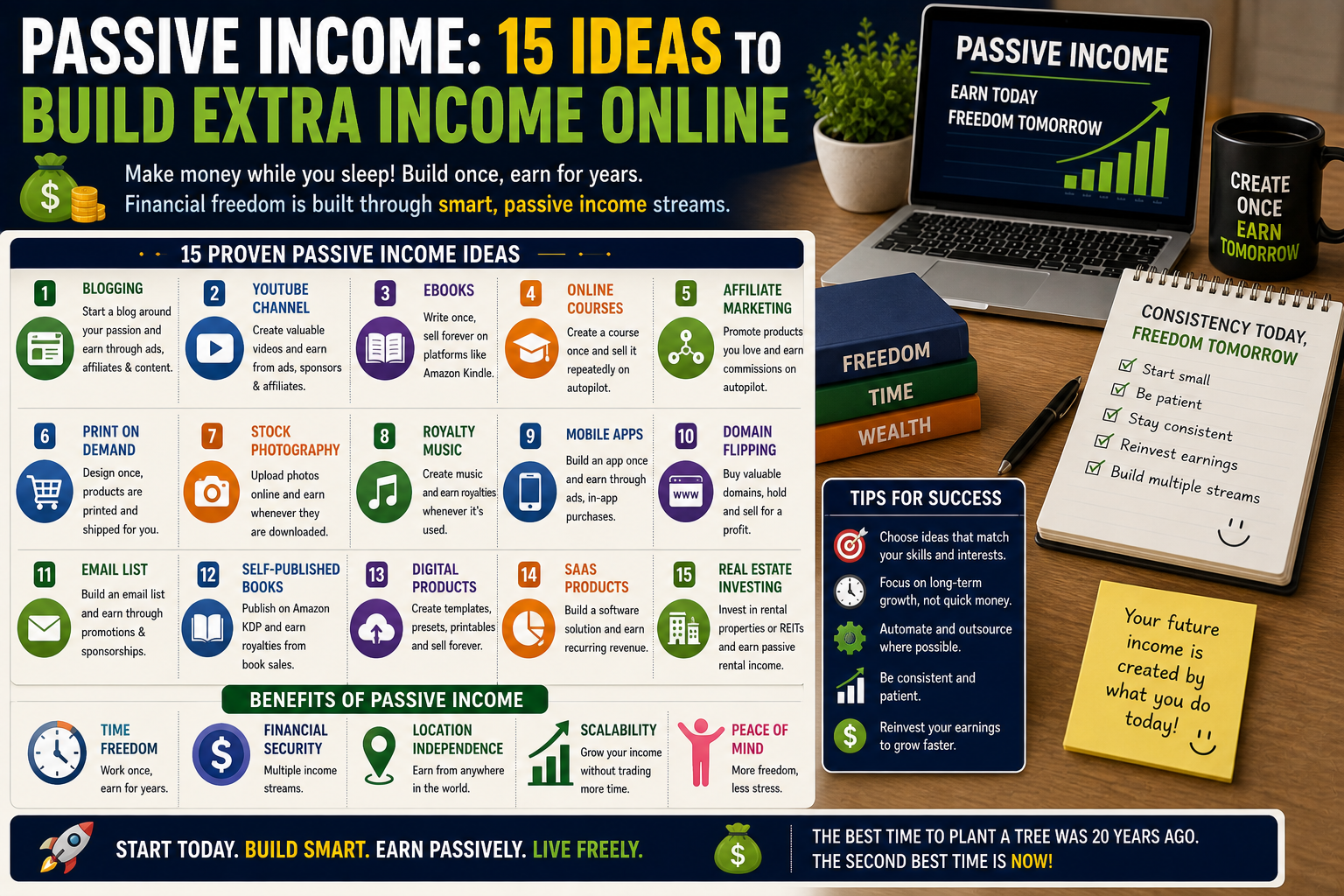
Passive income is money earned with relatively little ongoing day-to-day effort after an initial investment of time, money, or resources. It is often discussed as a way to diversify income and create additional financial opportunities. However, truly passive income is uncommon, and most income streams require some work to build, maintain, or manage.
Understanding how passive income works can help you identify realistic opportunities and avoid misleading promises about getting rich quickly.
What Is Passive Income?
Passive income generally refers to earnings that do not require continuous active work for every payment received. Instead, an asset, investment, digital product, or established business system may continue generating revenue after the initial work has been completed.
For example, someone might create a digital product and sell it repeatedly online. Another person might earn income from certain investments or from renting an asset.
The amount of ongoing effort varies significantly between different passive income sources. Some require regular maintenance, customer support, investment decisions, or management.
How Does Passive Income Work?
Most passive income opportunities require something upfront. This could be money, skills, time, creativity, or an existing asset.
For example, creating a useful online course may require substantial work before the first sale. Once published, however, the course may continue generating sales without requiring the creator to produce the same material for every customer.
Similarly, investments can potentially generate returns over time, although returns are never guaranteed and investments can lose value.
The key idea is that an asset or system continues producing potential income without requiring the same level of active effort as a traditional job.
Popular Passive Income Ideas
There are many ways people attempt to create passive or semi-passive income. The right option depends on available skills, resources, financial goals, and risk tolerance.
1. Dividend-Paying Investments
Some companies distribute part of their profits to shareholders in the form of dividends. Investors who own eligible shares may receive these payments according to the company’s dividend policy.
However, dividends are not guaranteed, and the value of the underlying investment can rise or fall. Investors should understand the risks before putting money into the market.
2. Rental Income
Owning a property and renting it to tenants can generate recurring income. Rental income may provide regular cash flow, but property ownership is not completely passive.
Maintenance, repairs, vacancies, taxes, insurance, and tenant management can all require time and money.
3. Digital Products
Digital products can include ebooks, templates, educational resources, design assets, or other downloadable products.
The main advantage is that a digital product can potentially be sold repeatedly without manufacturing a new physical item for every customer. However, successful digital products often require marketing, updates, customer support, and ongoing promotion.
4. Online Courses
People with useful knowledge or skills can create online courses and sell access to them.
Creating a high-quality course can require significant initial effort, including research, recording, editing, writing, and promotion. Once published, the course may generate sales with less ongoing work than creating a new course for every student.
5. Affiliate Marketing
Affiliate marketing involves promoting products or services and receiving a commission when qualifying purchases or actions occur through an affiliate link.
A website, blog, or content platform can potentially generate affiliate revenue from older content. However, traffic, audience trust, content quality, and the affiliate program’s terms can strongly influence results.
6. Stock Photography and Creative Assets
Photographers, designers, illustrators, and other creators can upload their work to platforms that license digital assets.
A single piece of work may potentially generate multiple sales or licensing payments. Competition can be high, however, and earnings depend on demand, quality, visibility, and platform policies.
7. Royalties
Creators may earn royalties from certain intellectual property, such as books, music, artwork, or licensed designs.
Royalties can provide recurring revenue when customers continue purchasing or licensing the underlying work. The amount earned depends on the agreement and demand for the work.
8. Print-on-Demand Products
Print-on-demand businesses allow creators to sell designs on products such as clothing, accessories, posters, or other merchandise.
A third-party provider typically handles production and fulfillment. This can reduce the need to hold inventory, but creators still need to develop designs, market products, manage listings, and deal with platform competition.
Is Passive Income Really Passive?
One of the biggest misconceptions about passive income is that it requires no work.
In reality, many passive income streams are better described as semi-passive income. They may require considerable effort at the beginning and occasional maintenance afterward.
For example, a blog can continue attracting visitors from older articles, but it may still require content updates, technical maintenance, search optimization, and audience development.
Likewise, rental property may generate recurring income but can involve repairs and tenant-related responsibilities.
Benefits of Passive Income
One potential benefit of passive income is diversification. Having multiple sources of income can reduce reliance on a single source, although it does not eliminate financial risk.
Passive income can also provide greater flexibility. A successful income-producing asset may continue generating revenue while you focus on work, education, family responsibilities, or other activities.
Another potential benefit is scalability. Some digital products and online businesses can serve many customers without requiring the same amount of additional work for every transaction.
Risks of Passive Income
Passive income is not guaranteed. Every opportunity has its own risks, costs, and limitations.
Investments can lose value. Rental properties can remain vacant or require expensive repairs. Online businesses can lose traffic. Digital products can become outdated, and affiliate programs can change their terms.
There is also an opportunity cost. Time or money spent building one income stream cannot be used elsewhere.
Before investing money or significant time, research the opportunity carefully and understand what could go wrong.
Passive Income vs Active Income
Active income usually involves directly exchanging time and effort for money. A salary, freelance payment, or hourly wage are common examples.
Passive income focuses more on assets or systems that can continue generating revenue after the initial work or investment.
The two approaches do not have to compete with each other. Many people use active income to build savings or investments that may eventually create additional income streams.
How to Start Building Passive Income
The first step is to identify your available resources. Consider your skills, interests, available time, starting budget, and financial goals.
Next, choose one realistic income stream instead of trying to build many at the same time. Learn how the model works and understand its costs and risks.
Start small when possible. Test your idea, measure the results, and improve it based on what you learn.
Most importantly, avoid opportunities that promise guaranteed profits or effortless wealth. Sustainable income usually requires patience, learning, and consistent effort.
How Long Does Passive Income Take to Build?
There is no universal timeline. Some income sources can begin generating small amounts relatively quickly, while others may take months or years to develop.
The timeline depends on the business model, initial investment, audience size, competition, skills, market demand, and consistency.
For example, building a profitable website or creating a substantial investment portfolio can take considerable time. Setting realistic expectations can help you avoid abandoning a legitimate strategy simply because results are not immediate.
Final Thoughts
Passive income can be a useful part of a broader financial strategy, but it should not be viewed as effortless or guaranteed money. Most passive and semi-passive income opportunities require an initial investment of time, money, skills, or resources.
Whether you choose digital products, investments, affiliate marketing, rental income, or another approach, research the opportunity carefully and understand its risks. Building sustainable additional income is generally a long-term process that benefits from realistic expectations and consistent effort.